Strengthens local governance systems by enabling citizens, Panchayats, and state institutions to make decisions rooted in data.
Strong local institutions are the backbone of a functional Democracy.
Our mission is to build resilient, inclusive, and future-ready rural economies that uphold dignity, sustainability, and shared prosperity for both people and the planet.
Strengthening Institutions for Inclusive Development
Building an India of Informed, Empowered & Responsible Citizens
Get Involved
Contribute your knowledge. Shape stronger public systems.
Collaborate to scale evidence-based democratic change.
Learn from the field. Build skills for democratic leadership.
Contribute your time, skills, and passion to strengthen governance.
Join us in strengthening evidence-based, accountable governance.
Strengthening Institutions for Inclusive Development
The Social Equity Wing of RACLD is mandated to design, facilitate, and scale interventions that address structural inequalities and ensure equitable access to rights, services, and opportunities for historically marginalised social groups. The wing operationalises the organisation’s commitment to inclusive governance, rights-based development, and social justice, prioritising communities traditionally excluded from mainstream development pathways.
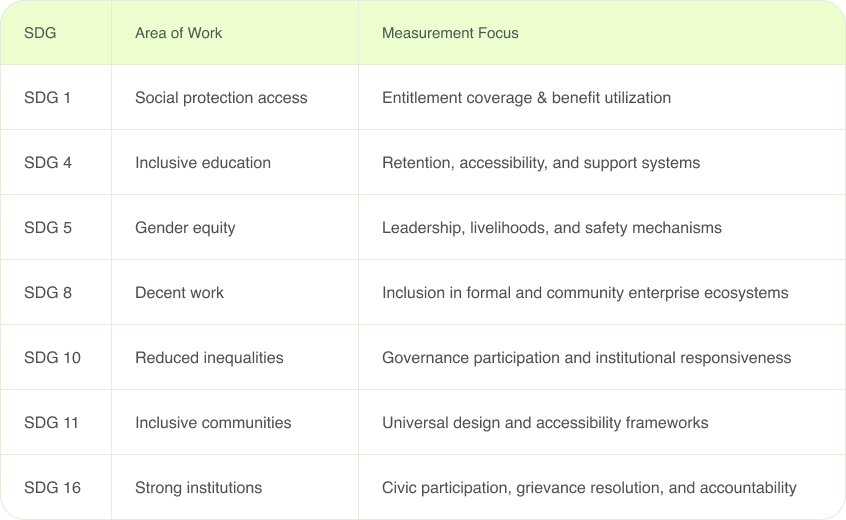
Our focus is grounded in India’s constitutional values and aligned with the Sustainable Development Goals (SDGs), particularly those aimed at reducing inequalities, strengthening democratic participation, and improving socio-economic inclusion.
Persistent inequities across social, gender, ability, and economic lines continue to limit democratic participation and restrict access to development outcomes.
Key systemic challenges include:
These challenges collectively contribute to intergenerational exclusion, reduced capability-building, and weaker democratic institutions, particularly at the grassroots. The Social Equity Wing addresses these inequities through strategic interventions, system strengthening, policy engagement, and community capacity development.
The wing operates through a four-pillar framework:
Strengthening community capacity to demand and secure legal and socio-economic entitlements.
Interventions include:
Enabling equitable participation and voice in panchayati raj institutions and local planning systems.
Activities include:
Creating pathways for secure livelihoods and social protection for marginalised groups through linkages, training, and enterprise support.
Components include:
Promoting rights-based inclusion of persons with disabilities through policy advocacy and operational frameworks.
Key efforts include:
No Poverty
Zero Hunger
Good Healthy And Well-being
Quality Education
Gender Equality
Clean Water And Santtion
Affordable And Clean Energy
Decent Work And Economic Growth
Industry, Innovation, Infrastructure
Reduced Inequalities
Sustainable Cities And Communities
Responsible Consumption, Production
Climate Action
Life Below Water
Life On Land
Peace, Justice And Strong Institutions
Partnerships For The Goals
Our methodology integrates evidence, participation, and systems thinking:
The Social Equity Wing aims to deliver measurable changes in:
We collaborate with:
Social equity is not merely a social aspiration — it is a democratic prerequisite.
Democracies remain incomplete when large sections of the population are excluded from public systems, governance processes, and development benefits. Achieving social equity requires fair institutions, responsive governance, and evidence-driven decision-making.
Central to this work is the strategic use of data.
Data enables us to:
By integrating disaggregated data, social audits, community scorecards, and participatory monitoring tools, we ensure that equity is not left to assumptions – it is measured, corrected, and continuously improved.
The Social Equity Wing ensures that democratic participation results in equitable development outcomes.
Through data-enabled decision-making, institutional strengthening, and community empowerment, we advance a governance ecosystem where every citizen is visible, every voice is valued, and every development pathway is equitable by design.
Our commitment is a democracy in which equity is embedded into systems, and whereSDG achievement becomes inclusive, measurable, and sustainable for all.
| SNo | Districts | Available Number of Panchayat | Total No of Panchayats | Percentage (%) |
|---|---|---|---|---|
| 1 | ARIYALUR | 61 | 201 | 30.35 |
| 2 | CHENGALPATTU | 86 | 359 | 23.96 |
| 3 | COIMBATORE | 83 | 228 | 36.40 |
| 4 | CUDDALORE | 140 | 683 | 20.50 |
| 5 | DHARMAPURI | 137 | 251 | 54.58 |
| 6 | DINDIGUL | 143 | 306 | 46.73 |
| 7 | ERODE | 137 | 225 | 60.89 |
| 8 | KALLAKURICHI | 89 | 412 | 21.60 |
| 9 | KANCHIPURAM | 54 | 274 | 19.71 |
| 10 | KANNIYAKUMARI | 41 | 95 | 43.16 |
| 11 | KARUR | 83 | 157 | 52.87 |
| 12 | KRISHNAGIRI | 156 | 352 | 44.32 |
| 13 | MADURAI | 120 | 420 | 28.57 |
| 14 | NAGAPATTINAM | 109 | 434 | 25.12 |
| 15 | NAMAKKAL | 120 | 322 | 37.27 |
| 16 | PERAMBALUR | 54 | 121 | 44.63 |
| 17 | PUDUKKOTTAI | 150 | 497 | 30.18 |
| 18 | RAMANATHAPURAM | 88 | 429 | 20.51 |
| 19 | RANIPET | 52 | 303 | 17.16 |
| 20 | SALEM | 168 | 343 | 48.98 |
| 21 | SIVAGANGA | 132 | 445 | 29.66 |
| 22 | TENKASI | 71 | 221 | 32.13 |
| 23 | THANJAVUR | 193 | 589 | 32.77 |
| 24 | THE NILGIRIS | 23 | 35 | 65.71 |
| 25 | THENI | 68 | 130 | 52.31 |
| 26 | THIRUVALLUR | 95 | 526 | 18.06 |
| 27 | THIRUVARUR | 122 | 430 | 28.37 |
| 28 | TIRUCHIRAPPALLI | 139 | 404 | 34.41 |
| 29 | TIRUNELVELI | 61 | 204 | 29.90 |
| 30 | TIRUPATHUR | 63 | 208 | 30.29 |
| 31 | TIRUPPUR | 116 | 265 | 43.77 |
| 32 | TIRUVANNAMALAI | 165 | 860 | 19.19 |
| 33 | TUTICORIN | 98 | 403 | 24.32 |
| 34 | VELLORE | 103 | 252 | 40.87 |
| 35 | VILLUPURAM | 134 | 693 | 19.34 |
| 36 | VIRUDHUNAGAR | 118 | 450 | 26.22 |
| TOTAL | 3772 | 12527 | 30.11 |