Equity Aligned With SDGs. Action Grounded in Communities

Social Equity Wing

Strengthening Institutions for Inclusive Development

The Social Equity Wing of RACLD is mandated to design, facilitate, and scale interventions that address structural inequalities and ensure equitable access to rights, services, and opportunities for historically marginalised social groups. The wing operationalises the organisation’s commitment to inclusive governance, rights-based development, and social justice, prioritising communities traditionally excluded from mainstream development pathways.

Our focus is grounded in India’s constitutional values and aligned with the Sustainable Development Goals (SDGs), particularly those aimed at reducing inequalities, strengthening democratic participation, and improving socio-economic inclusion.

Rationale and Problem Statement

Persistent inequities across social, gender, ability, and economic lines continue to limit democratic participation and restrict access to development outcomes. 


Key systemic challenges include: 

  • Unequal access to entitlements, public services, and welfare systems
  • Limited representation and voice in local governance structures
  • Socio-cultural barriers that marginalise women, youth, and vulnerable groups 
  • Lack of inclusive infrastructure, digital access, and institutional responsiveness 
  • Exclusion of persons with disabilities due to physical, attitudinal, and systemic constraints 

These challenges collectively contribute to intergenerational exclusion, reduced capability-building, and weaker democratic institutions, particularly at the grassroots. The Social Equity Wing addresses these inequities through strategic interventions, system strengthening, policy engagement, and community capacity development. 

Strategic Framework

The wing operates through a four-pillar framework: 

Rights Awareness &  Institutional Access

Strengthening community capacity to demand and secure legal and socio-economic entitlements. 

Interventions include: 

  • Public entitlement facilitation (PDS, pensions, health, education)
  • Legal literacy workshops 
  • One-stop access support for vulnerable households
  • Governance interface facilitation between communities and local authorities 
Inclusion & Representation  in Governance

Enabling equitable participation and voice in panchayati raj institutions and local planning systems. 

Activities include: 

  • Capacity building of the marginalised sections of the society 
  • Participatory planning integration into GPDP and ward-level planning 
  • Community scorecards, social audits, and accountability platforms 
  • Data and documentation for evidence-led governance reforms 
Livelihood Inclusion &  Economic Empowerment

Creating pathways for secure livelihoods and social protection for marginalised groups through linkages, training, and enterprise support. 

Components include: 

  • Market-linked skilling and employability programs 
  • Inclusion of vulnerable groups in government livelihood schemes 
  • Entrepreneurship incubation for women, youth, and PWDs 
  • Linkages to self-help groups, FPOs, cooperatives, and MSME ecosystems 
Accessibility, Disability  Inclusion & System Reform 

Promoting rights-based inclusion of persons with disabilities through policy advocacy and operational frameworks. 

Key efforts include: 

  • Accessibility ecosystem mapping (infrastructure, services, information) 
  • Inclusive design recommendations for institutions 
  • Disability certification and entitlements integration
  • Inclusive employment pathways and digital participation tools 

SDGs - Sustainable Development Goals

01

No Poverty

02

Zero Hunger

03

Good Healthy And Well-being

04

Quality 
Education

05

Gender 
Equality

06

Clean Water And Santtion

07

Affordable And Clean Energy

08

Decent Work And Economic Growth

09

Industry, Innovation, Infrastructure

10

Reduced
Inequalities

11

Sustainable Cities And Communities

12

Responsible Consumption, Production

13

Climate Action

14

Life Below Water

15

Life On Land

16

Peace, Justice And Strong Institutions

17

Partnerships For The Goals

SDG Alignment

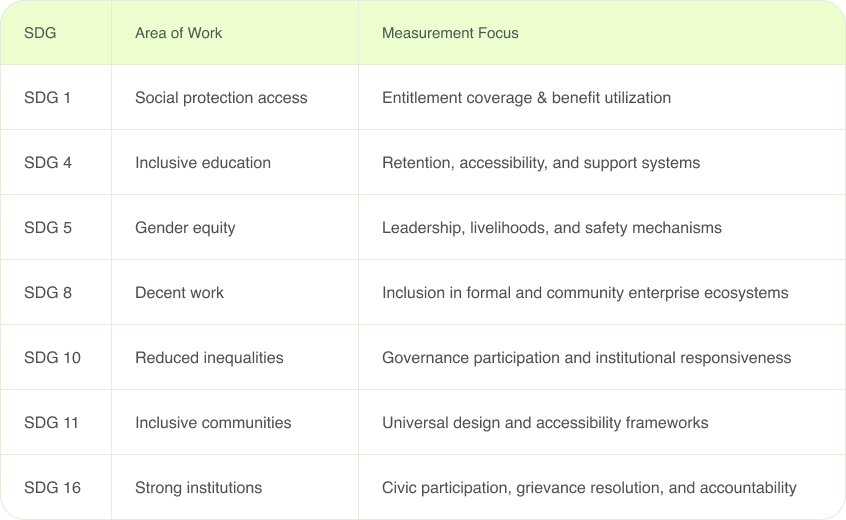
The wing directly advances multiple SDGs  with measurable indicators: 

Operational Methodology 

Our methodology integrates evidence, participation, and systems thinking: 

  • Baseline assessments using vulnerability indexing, accessibility mapping, and socio-economic profiling 
  • Participatory planning models (PLA, PRA, local consultations, and rights mapping) 
  • Capability enhancement through training, leadership development, and peer networks
  • Systems integration with state and local government programs 
  • Monitoring & evaluation using rights-based and outcome-driven indicators 
  • Policy interface engagement for scaling and framework adoption 
Impact Outcomes

The Social Equity Wing aims to deliver measurable changes in: 

  • Improved access to welfare, health, education, and protection services 
  • Increased leadership and representation of marginalised groups in governance 
  • Enhanced social mobility, livelihoods, and economic independence 
  • Strengthened institutional accountability and responsiveness 
  • Reduced socio-cultural barriers and discriminatory practices 
  • Improved inclusion and accessibility for persons with disabilities 
Partnership Model 

We collaborate with: 

  • Local governments and Panchayati Raj Institutions 
  • Civil society networks and community institutions
  • Government departments and national missions
  • International development actors
  • Private sector and CSR partners
  • Research and academic institutions 

Equity as the Foundation of Democracy

Social equity is not merely a social aspiration — it is a democratic prerequisite.

Democracies remain incomplete when large sections of the population are excluded from public systems, governance processes, and development benefits. Achieving social equity requires fair institutions, responsive governance, and evidence-driven decision-making.

Central to this work is the strategic use of data.

Data enables us to:

  • Map vulnerabilities and identify exclusion patterns
  • Track service delivery gaps and disparities across geographies
  • Strengthen evidence-based planning in local governance
  • Monitor SDG progress at the grassroots level
  • Drive public accountability and institutional responsiveness
  • Ensure that the most marginalised populations are systematically included


By integrating disaggregated data, social audits, community scorecards, and participatory monitoring tools, we ensure that equity is not left to assumptions – it is measured, corrected, and continuously improved.

The Social Equity Wing ensures that democratic participation results in equitable development outcomes.

Through data-enabled decision-making, institutional strengthening, and community empowerment, we advance a governance ecosystem where every citizen is visible, every voice is valued, and every development pathway is equitable by design.

Our commitment is a democracy in which equity is embedded into systems, and whereSDG achievement becomes inclusive, measurable, and sustainable for all.

Join us

Help us strengthen evidence-based governance across India.